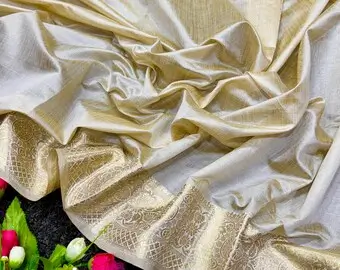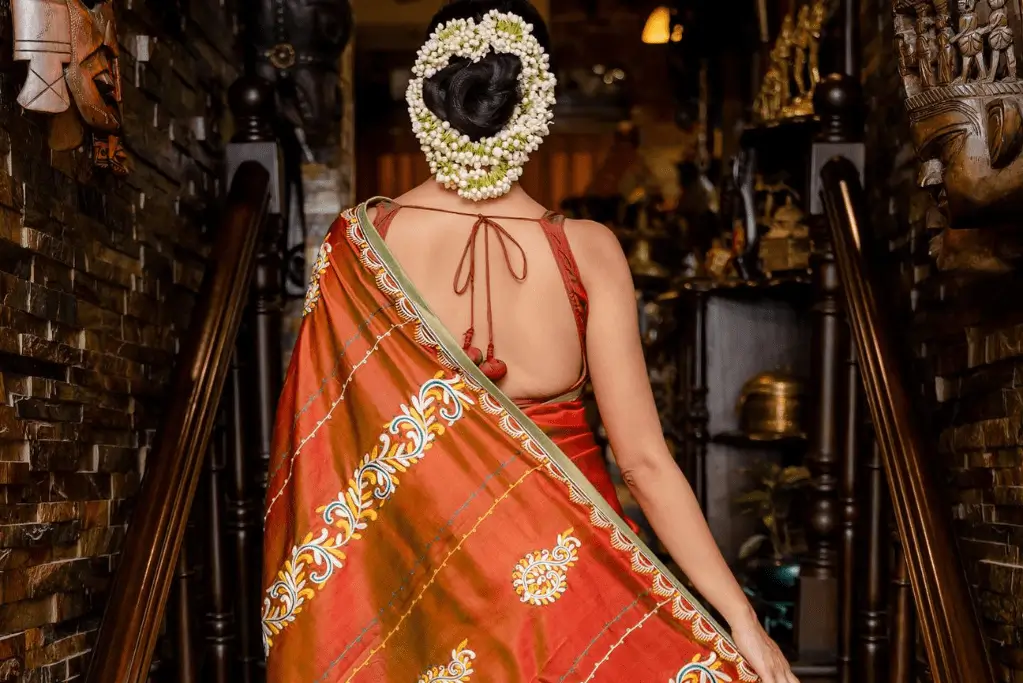


One such garment, which has never lost its significance as a traditional Indian outfit, is the Banarasi saree. And, one such variant of these sarees, the Banarasi Jacquard Saree, has been a kind of break from the tradition, in terms of textile evolution. The sarees hold the splendour of traditional motifs while optimising jacquard weaving methods to weave complex designs with mechanical accuracy.
Knowing the Jacquard way of weaving
Unlike hand-loomed sarees, Banarasi Jacquard Saree is produced on a loom with a jacquard head, enabling the weaver to produce intricate designs using punch cards or digital software. This technique allows craft workers to work elaborate and uniform designs more easily. The result is a beautiful and consistent pattern that has the look of a handmade weave with the accuracy and ease of a computer-generated design.
The modern weave of banarasi essence
What sets a Banarasi Jacquard Saree apart from other jacquard sarees is the regional work involved. These are all Varanasi-weaved sarees that include classic Banarasi motifs – such as floral butis, paisley, and Mughal-inspired jaal work – in a faster, loom-assisted technique of production. This fusion approach maintains the core of Banarasi heritage, while capturing the interest of today’s time-strapped consumers.
Richness of fabric and feel
Banarasi sarees are known for their rich silks, and Banarasi Jacquard Sarees continue that tradition. They are usually woven from well-blended silks or from silks mixed with cotton, being soft, cool, and rich in appearance and drape. Though the thickness of a regular saree may differ for hand weaving, the texture remains the same in the length of a jacquard saree.
Decoration and diversity of design
Since any potential colour/pattern could be inserted anywhere within the loom, the location of colour is less important in jacquard woven fabric than in printed fabric. While it takes weeks to weave one detailed pattern from a traditional Banarasi saree, the Banarasi Jacquard Sarees help bring out a wider scope of motifs in little time. From modern geometric patterns to classic floral vines, these sarees have given wearers the variety they craved, without losing the essence of the Banarasi.
Time and cost efficiency
Making a traditional Banarasi saree handloom is time-consuming, involving two to four people working on the loom, and two to three weeks are required to weave a single saree. Jacquard looms diminish this cost disparity, making gorgeousness more within reach. For buyers who adore classic crafts but are restricted in budget, the Banarasi Jacquard saree stands as a more affordable option in terms of price and availability.
Great for grand comfortable style
Banarasi traditional sarees are wonderful, but may end up being weighty if worn for long hours. Banarasi Jacquard Sarees, Bangalore silk sarees are usually lighter in weight, making them a perfect choice for prolonged wedding days, weddings, receptions and festivals. You get the royal look while pulling a comfort!
Versatility across occasions
Be it a wedding, an office party or a religious assembly, the Banarasi Jacquard Saree adjusts with ease. Tage Deluxe Gold Black Bracelet, 50 rose. Its sophisticated patterns and elegant shine are suitable for formal and semi-formal occasions. You may match it with a slim fit blouse for a corporate look, or you can try a little style with the traditional him for an ethnic touch.
Savouring the beauty in technology
Technology in weaving doesn’t make the art weaker — it’s just different. Albeli weavers use Jacquard looms to enable each Banarasi Jacquard Saree to bear the heritage of Varanasi and the modern innovation of intricate weaving. These sarees are proof of how traditional crafts can change and evolve without abandoning their roots.
Maintenance of saree vis-à-vis traditional saree
Handloom sarees usually need dry cleaning and should be treated with mild soaps. Although luxurious, Jacquard fabrics are usually more manageable in everyday life. The uniform weave style of these sarees also makes them more resistant to snags and creases, which is great for daily wear or for beginners.
Sustainable and scalable
Banarasi Jacquard Sarees are a sustainable alternative to fad fashion, as they are made with craftsmanship and good threads. The jacquard loom process even opens possibilities for scale without sacrificing artisan good, so the duo can offer it sustainably in terms of both design and delivery. Albeli ensures that every saree is held up to that mark of durability and style.
Why banarasi jacquard sarees are much loved by millennials
Banarasi Jacquard Saree Achieving the perfect blend of heritage and comfort, the Banarasi Jacquard Saree is gaining acceptance among the millennials. These sarees are in sync with their love for statement fashion, which has traditional roots. They are an ideal choice for destination weddings, party selfies or in-office parties.
You can very well wear these shorts with belts, jackets, or the most recent styles of blouses. Albeli’s designs, which are both fresh and customizable, have found a new set of takers in younger generations. Information card while tucking into some spicy kachoris, or dressing up for your cousin’s big day while keeping cred with Instagram — but all with a nod to Indian craft.
Perfect match: how to style your jacquard saree
Styling a Banarasi Saree is all about blending traditional with contemporary. Wear embroidered blouses or silk blouses of contrasting colours to emphasise the saree’s jacquard texture. Gold jhumkas or pearl chokers add to its majestic look.
Combine it with ethnic hand clutches and high-heeled sandals to look more beautiful. You could also drape it like a lehenga or play with pre-stitched pleats for a modern take. Albeli’s team provides styling inspiration with every purchase, so you look picture-perfect at any occasion, whether it is a family wedding or an official cultural event.
How to take care of your banarasi jacquard saree
Take good care, and your Banarasi Jacquard Saree will be with you for many years to come. Keep it in a muslin cloth at all times, to let the fabric breathe and avoid moisture. Heavy silk Sarees should not be hung for very long periods, as this will cause stretching in the fabric.
Dry clean the saree for the first time, and thereafter hand wash in cold water using a mild detergent. Iron at a low temperature, on the other hand, is used to protect the details of the fine jacquard. With good care, your saree will remain beautiful for a lifetime.
Albeli playing an instrumental role in modern banarasi
Ready to go old-school with a modern moment? Discover the stunning range of Banarasi Jacquard Sarees from Albeli: Best Banarasi Saree Manufacturer in Varanasi, woven with cultural honour and technical perfection. For a closer look or to make a purchase, you can video call Albeli, have an up-close and personal experience of their creations and shop with expert guidance.